
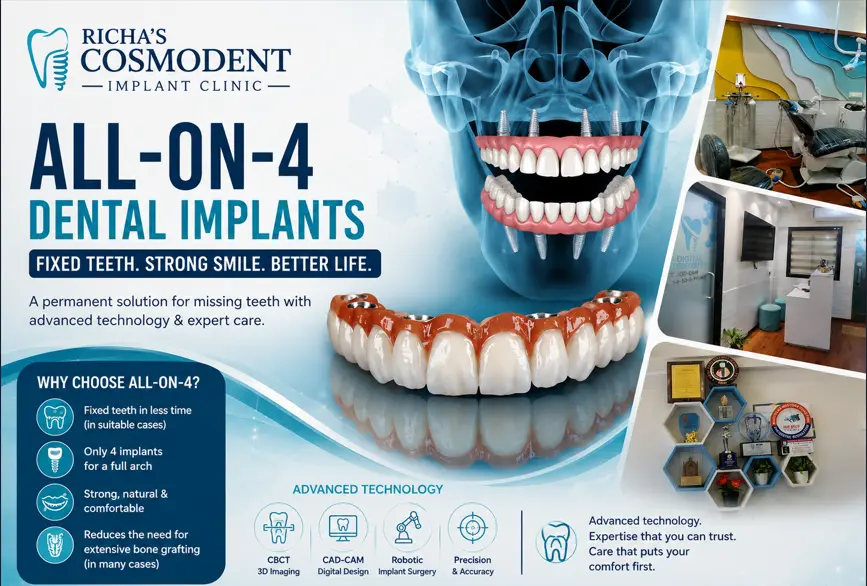
Losing several teeth can affect much more than your smile. Difficulty chewing, avoiding certain foods, changes in speech and feeling uncomfortable with removable dentures can gradually affect your confidence and everyday life. But if you have multiple missing teeth or a failing set of teeth, you may not need an individual implant for every missing tooth.
All-on-4 dental implants offer a full-arch treatment approach that can support a fixed set of replacement teeth using just four strategically positioned dental implants. For suitable patients, this can provide a stable alternative to conventional dentures and may reduce the need for extensive bone-grafting procedures.
If you are searching for an All-on-4 dental implant in Mumbai, especially around Mira Road and nearby areas, understanding how the treatment works, who can benefit from it, its limitations, recovery and cost can help you make a more informed decision.
What Are All-on-4 Dental Implants?
All-on-4 is a full-arch dental implant treatment designed to replace most or all teeth in one dental arch with a fixed implant-supported prosthesis.
Instead of placing one implant for every missing tooth, the treatment generally uses four dental implants to support a full arch of replacement teeth. The implants are positioned strategically to make use of available jawbone and provide support for the prosthesis.
This approach can be considered for people who have:
- Multiple missing teeth
- Severely damaged or failing teeth
- Extensive tooth loss
- Loose or uncomfortable dentures
- Significant bone loss that makes conventional implant placement more challenging
- A need for fixed teeth rather than removable dentures
Importantly, All-on-4 is not automatically suitable for every patient. Your available bone, gum health, bite, medical history, remaining teeth and overall oral condition need to be assessed before treatment.
A clinical examination and appropriate imaging, such as CBCT, can help the dental implant specialist understand your bone volume and anatomical structures before planning treatment.
How Does All-on-4 Work?
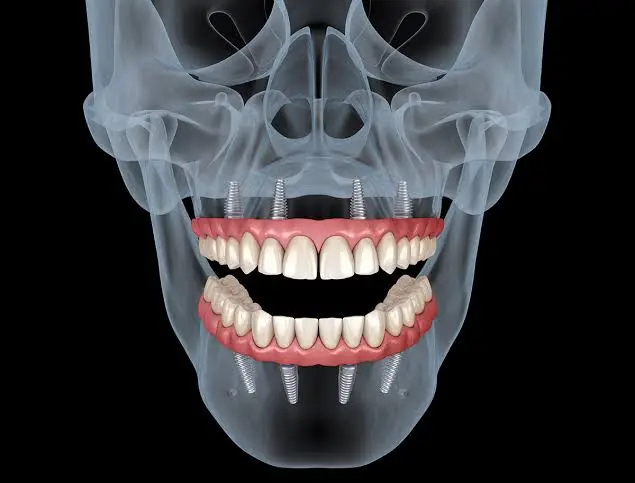
The basic concept is to use four strategically positioned implants to support a complete arch of artificial teeth.
Typically, two implants are placed toward the front of the jaw while the posterior implants may be angled. This positioning can help make better use of the available bone and, in selected cases, avoid or reduce the need for extensive bone augmentation.
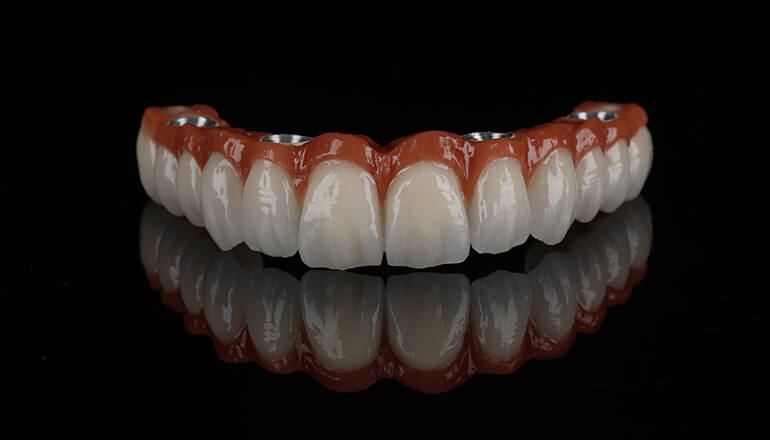
The final restoration is attached to the implants, creating a fixed set of replacement teeth.
The treatment usually involves three important stages:
1. Diagnosis and planning
Your dentist examines your teeth, gums, bite and jawbone. Digital scans and CBCT imaging may be used to understand the anatomy and plan implant positions.
2. Implant placement
The four implants are surgically positioned according to the treatment plan.
3. Fixed prosthesis
Depending on your individual clinical situation and implant stability, a provisional fixed restoration may be provided soon after implant placement. The final prosthesis is generally planned after the implants and surrounding tissues have had appropriate time to heal.
Immediate loading is not guaranteed. It depends on factors such as primary implant stability, bone quality, overall health and the clinician’s assessment. Clinical consensus recommendations specifically emphasize adequate implant stability and appropriate prosthetic planning when immediate loading is considered.
Who Is a Good Candidate?
All-on-4 can be an option for adults who have lost most or all teeth in an arch or whose remaining teeth have a poor long-term prognosis.
You may be considered for All-on-4 if you have:
- Multiple missing teeth
- Severely damaged or failing teeth
- Advanced tooth loss
- Difficulty using conventional dentures
- Adequate bone in strategic areas for implant placement
- Healthy or controllable gum tissues
- Sufficient general health for oral surgery
However, the final decision should never be based on symptoms alone.
For example, a patient with severe bone loss may require a different approach, such as bone grafting, sinus augmentation or, in selected cases, zygomatic implants.
Similarly, uncontrolled gum disease, certain medical conditions, poor oral hygiene or smoking may affect treatment planning and long-term implant health.
This is why consultation with an experienced dental implant specialist in Mumbai is important before deciding between All-on-4, All-on-6, conventional implants or another full-mouth rehabilitation option.
All-on-4 Procedure Step by Step
Although every patient’s treatment plan is different, the process generally follows these stages.
1. Initial consultation
Your dentist discusses your concerns, missing teeth, previous dental treatments and expectations.
2. Clinical examination
The dentist checks your gums, remaining teeth, bite and oral tissues.
3. Digital imaging and planning
CBCT and other digital diagnostic tools can help evaluate bone volume, anatomical structures and potential implant positions.
4. Treatment planning
Your implant specialist determines whether All-on-4 is appropriate and discusses alternatives if necessary.
5. Implant placement
Four implants are placed in the selected arch according to the planned positions.
6. Provisional teeth
If your clinical condition allows immediate loading, a temporary fixed prosthesis may be attached according to the treatment protocol.
7. Healing and monitoring
Follow-up appointments allow the dental team to monitor healing, implant stability and oral hygiene.
8. Final restoration
After appropriate healing and clinical assessment, the definitive full-arch prosthesis can be fabricated and fitted.
The exact timeline varies significantly from patient to patient, so promises such as “fixed teeth in one day” should always be understood as case-dependent, rather than guaranteed for everyone.
Can All-on-4 Provide Fixed Teeth Immediately?
Sometimes, yes.
A key advantage of the All-on-4 approach is that, in carefully selected cases, patients may be able to receive a temporary set of fixed teeth soon after the implants are placed. However, immediate fixed teeth are not suitable for every patient.
The decision depends on factors including:
- Primary implant stability
- Bone quality and quantity
- Implant position
- Bite forces
- Overall oral health
- The condition of the opposing arch
- The type and design of the provisional restoration
Research has reported predictable outcomes for appropriately selected All-on-4 cases, while also emphasizing the importance of proper patient selection and long-term maintenance.
Therefore, if you are searching for same-day dental implants in Mumbai, ask your implant specialist whether immediate loading is clinically appropriate for your specific case rather than assuming it is available to everyone.
All-on-4 vs Traditional Implants
The main difference is the number and distribution of implants and how the final teeth are supported.
With traditional implant treatment, a patient may receive individual implants to replace individual teeth or multiple implants to support a bridge.
All-on-4, on the other hand, is designed to support an entire dental arch using four strategically placed implants.
All-on-4 may offer:
- Full-arch fixed teeth
- Fewer implants for an entire arch
- A streamlined treatment concept
- Potentially less extensive bone augmentation in selected cases
- An alternative to removable dentures
Traditional implants may be more appropriate when only a few teeth are missing or when individual tooth replacement offers a better functional and aesthetic solution.
The right choice depends on your teeth, bone, gums, bite and long-term treatment goals.
All-on-4 vs Dentures
Traditional dentures are removable appliances that replace missing teeth and surrounding tissues.
They can restore basic chewing and appearance, but some patients find that dentures move while eating or speaking. Denture adhesives may also be required in certain cases.
All-on-4 uses implants anchored into the jawbone to support a fixed prosthesis.
| All-on-4 | Traditional Dentures |
|---|---|
| Implant-supported | Removable |
| Fixed prosthesis | Can move during use |
| Does not need daily removal in the same way as dentures | Removed for cleaning |
| Provides implant-based stability | Relies largely on gum and tissue support |
| Requires implant surgery | No implant surgery |
However, All-on-4 is a surgical treatment and requires careful planning, maintenance and regular professional follow-up.
All-on-4 vs All-on-6
Both treatments aim to provide a fixed full-arch restoration, but they use different numbers of implants.
All-on-4: Four implants support the arch.
All-on-6: Six implants are used to support the arch.
More implants do not automatically mean a better treatment. Your available bone, implant distribution, bite, prosthetic design and individual anatomy determine which approach is more appropriate.
For some patients, All-on-4 can provide an efficient full-arch solution. Others may benefit from All-on-6 or conventional implant treatment.
A detailed evaluation is therefore more important than choosing a treatment based only on the number of implants.
Is Bone Grafting Required?
Not always.
One potential advantage of the All-on-4 concept is that strategically positioned implants can make use of available bone and, in selected cases, reduce the need for extensive bone augmentation.
However, this does not mean that All-on-4 eliminates the need for bone grafting in every patient.
Bone loss can occur after tooth loss, and some patients may have insufficient bone even for strategically positioned implants.
Depending on the condition of the jaw, treatment options may include:
- Bone grafting
- Sinus lift
- Alternative implant positioning
- All-on-6
- Zygomatic implants in selected severe upper-jaw bone-loss cases
- Other forms of full-mouth rehabilitation
CBCT-based planning is particularly valuable when assessing these options.
All-on-4 Cost in Mumbai
The All-on-4 dental implant cost in Mumbai varies from patient to patient.
There is no responsible single price that applies to everyone because the overall treatment may depend on:
- Number of arches being treated
- Condition of existing teeth
- Extractions required
- Bone availability
- Implant system used
- Type of provisional prosthesis
- Final prosthetic material
- Digital planning requirements
- Additional procedures
- Complexity of the case
- Follow-up and maintenance requirements
Therefore, instead of choosing an implant clinic based only on the lowest quoted price, ask what the treatment package actually includes.
A proper consultation with a dental implant specialist in Mumbai can provide a more meaningful estimate after examining your oral condition and diagnostic scans.
Recovery
Some swelling, discomfort or sensitivity can occur after implant surgery. Your dental team will provide specific instructions depending on your procedure.
Once your implant procedure is complete, following your dentist’s aftercare instructions can help protect the surgical area and support proper healing. These may include:
- Follow the recommended diet
- Maintain careful oral hygiene
- Take prescribed medication as directed
- Avoid smoking
- Avoid excessive pressure on the healing area
- Attend scheduled follow-up appointments
If you receive a provisional fixed prosthesis, your dentist may also recommend dietary restrictions while the implants heal.
Long-term success depends not only on the surgery but also on daily hygiene, regular dental check-ups and professional maintenance.
How Long Does All-on-4 Last?
All-on-4 implants are designed as a long-term tooth-replacement solution, but no dental implant treatment can be guaranteed to last forever.
Clinical evidence suggests that All-on-4 can have high implant survival in appropriately selected patients, although complications such as peri-implant disease and prosthetic problems can occur.
The longevity of your treatment can be influenced by:
- Oral hygiene
- Gum health
- Smoking
- Bite forces
- Overall health
- Quality of prosthetic care
- Regular maintenance
- Professional dental check-ups
Remember: the implants and the prosthetic teeth are different components. The prosthesis may require repair, adjustment or replacement over time even when the implants remain healthy.
Meet Our Dental Experts

Dr. Richa Mehta
BDS, MDS, FAGE
Prosthodontist & Cosmetic Dentist
Dr. Richa Mehta focuses on restoring both the function and appearance of the smile. Her areas of dentistry include prosthodontics, cosmetic dentistry, smile designing, veneers, ceramic crowns, bridges, dentures and full-mouth rehabilitation.
Her approach emphasizes careful treatment planning, attention to detail and patient comfort throughout the treatment journey.
Dr. Swapnil Pande

BDS, MDS (Implantology)
Leading Implant Specialist & Prosthodontist in Mumbai
Dr. Swapnil Pande focuses on advanced dental implantology and prosthodontics, including treatment planning for patients requiring single-tooth replacement as well as full-mouth dental implant rehabilitation.
His approach combines clinical experience with digital planning and evidence-based implant techniques to develop individualized treatment plans.
At Richa’s Cosmodent Implant Clinic, advanced technology can play an important role in treatment planning and execution. Depending on the case, the clinic uses technologies and digital dentistry solutions such as CBCT, CAD-CAM, digital workflows and robotic implant technology to support accurate planning and personalized treatment.
Technology, however, is only one part of successful implant treatment. Proper diagnosis, clinical experience, patient selection, prosthetic planning and long-term maintenance remain equally important.
Why Consider All-on-4 Dental Implants in Mumbai?
If you have extensive tooth loss and are looking for a fixed alternative to conventional dentures, All-on-4 may be worth discussing with an experienced implant specialist.
For patients in Mumbai, Mira Road and surrounding areas, the first step should be a comprehensive clinical assessment rather than choosing a treatment based on advertisements or a fixed price.
At Richa’s Cosmodent Implant Clinic, treatment planning can involve digital diagnostics and advanced implant technologies, with the goal of selecting an approach that fits the patient’s individual oral condition.
Whether you need dental implants in Mumbai, full-mouth rehabilitation, All-on-4, All-on-6 or another implant solution, the appropriate treatment should be determined after an examination and diagnostic evaluation.
Frequently Asked Questions
Is All-on-4 better than dentures?
All-on-4 provides implant-supported fixed teeth, while conventional dentures are removable. However, neither option is universally better. Your oral health, bone condition, budget and treatment goals should determine the appropriate choice.
Is All-on-4 suitable for someone with bone loss?
It can be suitable for some patients with bone loss because the implant positions are planned to maximize available bone. However, significant bone loss may require bone grafting or another implant solution.
Can I get All-on-4 if I still have some teeth?
Potentially. Patients with severely damaged or non-restorable teeth may be considered for full-arch rehabilitation. Your dentist needs to assess whether the remaining teeth can be predictably retained.
Is All-on-4 painful?
The procedure is performed under appropriate local anaesthesia and, when indicated, sedation options may be discussed. Some discomfort and swelling can occur during recovery, but your dental team will provide post-operative instructions and medication when appropriate.
Can All-on-4 be done in one day?
The implant placement and provisional fixed teeth may sometimes be completed within a short period for carefully selected patients. However, immediate loading is not appropriate for everyone. The final decision depends on implant stability, bone conditions and other clinical factors.
How many implants are used in All-on-4?
The treatment concept uses four strategically positioned implants to support a full-arch prosthesis.
What is the difference between All-on-4 and All-on-6?
All-on-4 uses four implants, while All-on-6 uses six. The best option depends on bone availability, implant positioning, bite, prosthetic requirements and your overall treatment plan.
How much does All-on-4 cost in Mumbai?
The cost varies depending on the number of arches, implant system, prosthetic material, existing teeth, additional procedures and complexity of treatment. A personalized estimate should be provided after clinical examination and diagnostic evaluation.
How do I choose an All-on-4 dental implant specialist in Mumbai?
Look for appropriate implantology and prosthodontic expertise, experience with full-mouth rehabilitation, proper diagnostic planning, transparent treatment information, appropriate technology and a clear long-term maintenance plan.
Take the First Step Towards a More Stable Smile
If missing teeth, failing teeth or uncomfortable dentures are affecting your ability to eat, speak or smile confidently, All-on-4 dental implants may be one of the treatment options worth discussing.
The right solution depends on your individual bone condition, gums, remaining teeth, bite and overall oral health.
A consultation with an experienced dental implant specialist in Mumbai can help you understand whether All-on-4, All-on-6, conventional dental implants or another full-mouth rehabilitation approach is more suitable for you.
Richa’s Cosmodent Implant Clinic, Mira Road, Mumbai can evaluate your condition and discuss the available treatment options based on your clinical requirements.
Book a consultation to understand your treatment options and receive a personalized implant treatment plan.
Leave a Reply