
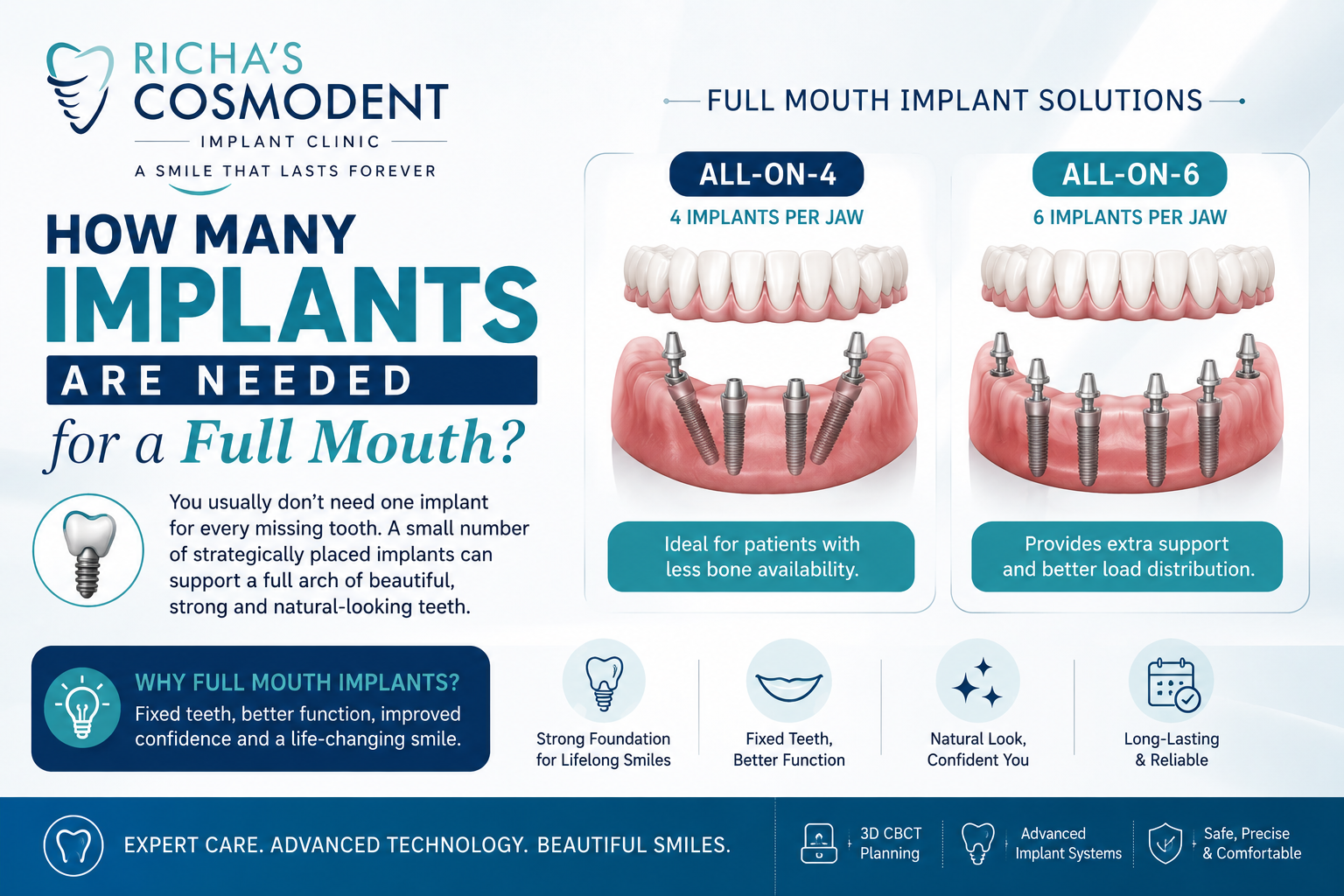
Short answer: Most people need around 4 to 8 dental implants per jaw for a full-arch restoration. For both the upper and lower jaws, this can mean approximately 8 to 16 implants in total. However, the exact number depends on your bone quality, jaw anatomy, bite, treatment goals, and the type of full-mouth dental implant solution recommended by your implant specialist.
If you are missing most or all of your teeth, you may assume that replacing a full mouth means getting one dental implant for every missing tooth. Fortunately, that is not usually necessary.
Modern full mouth dental implants use a carefully planned number of implants to support an entire set of replacement teeth. Depending on the treatment plan, your dentist may recommend an All-on-4, All-on-6, or another full-arch implant-supported solution.
At Richa’s Cosmodent Implant Clinic, patients looking for dental implants in Mumbai can receive a personalised assessment to determine how many implants are needed for their specific mouth. The right number is not simply the highest number of implants—it is the number that provides suitable support, stability and long-term function for your individual case.
How Many Dental Implants Are Needed for a Full Mouth?
Answer:
For a complete full-mouth restoration, the number of dental implants commonly falls within these ranges:
- All-on-4: 4 implants for one jaw
- All-on-6: 6 implants for one jaw
- 6 to 8 implants: May be used in selected cases for a full fixed bridge
- 8 to 16 implants total: A possible range when both the upper and lower arches are restored
A full dental arch refers to either:
- All upper teeth, or
- All lower teeth
Therefore, if both arches need replacement, your treatment plan will usually involve separate planning for the upper and lower jaws.
Entity:
Dental implants are small biocompatible posts placed into the jawbone to act as artificial tooth roots. After healing and integration with the bone, they can support crowns, bridges or full-arch teeth.
Evidence:
A full arch can commonly be supported by multiple implants rather than one implant per tooth. Cleveland Clinic notes that full-arch implant restorations usually involve four to six implants, while the exact number depends on the treatment plan and available bone.
Source:
A professional implant assessment may include a clinical examination and three-dimensional imaging such as a CBCT scan to evaluate bone availability and determine the safest and most suitable implant positions.
Product:
Depending on the treatment plan, patients may receive:
- All-on-4 dental implants
- All-on-6 dental implants
- Implant-supported fixed bridges
- Full-mouth implant rehabilitation
- Implant-supported dentures
- Advanced implant solutions for reduced bone availability
Do You Need One Implant for Every Missing Tooth?
No.
This is one of the biggest misconceptions about dental implants.
If you have lost an entire set of teeth, you do not necessarily need 14 implants to replace 14 teeth. Several replacement teeth can be joined together in a bridge or full-arch prosthesis and supported by strategically placed implants.
For example, four dental implants may support an entire arch of replacement teeth in an All-on-4 treatment. Six implants may support a larger or differently designed full-arch restoration in an All-on-6 treatment.
The goal is not to place as many implants as possible. The goal is to create a stable and well-distributed foundation for your new teeth.
What Is All-on-4?
Answer:
All-on-4 is a full-arch dental implant treatment that uses four strategically placed implants to support a complete set of replacement teeth.
Two implants are generally placed towards the front of the jaw, while the posterior implants may be angled to make better use of the available bone.
Entity:
All-on-4 dental implants are a fixed full-arch solution designed for patients who have lost most or all teeth in one jaw.
Evidence:
This concept can provide a complete arch of teeth using four implants and may be considered when bone availability is limited in certain areas. Cleveland Clinic describes All-on-4 as a type of fixed implant-supported denture used to replace an entire dental arch.
Source:
Whether All-on-4 is suitable depends on factors such as:
- Jawbone quantity and density
- Gum health
- Bite force
- Overall oral condition
- Medical history
- Location of available bone
Product:
An All-on-4 treatment may include:
- Four dental implants
- A temporary fixed restoration where clinically appropriate
- A final full-arch prosthesis
- Regular follow-up and maintenance
What Is All-on-6?
Answer:
All-on-6 uses six dental implants to support a full arch of replacement teeth.
The additional implants can provide extra support and distribute chewing forces across more implant sites.
Entity:
All-on-6 dental implants are commonly considered for patients with suitable bone availability who require a stable, fixed full-arch restoration.
Evidence:
The treatment is based on placing six implants at carefully planned locations and attaching a full-arch restoration to them. However, having six implants does not automatically make All-on-6 better for every patient.
The condition of your jaw and the quality of treatment planning are more important than simply choosing a higher implant number. Richa’s Cosmodent Implant Clinic explains that bone condition, gums, bite, remaining teeth and treatment expectations should all be considered when planning full-arch implant treatment.
Source:
A CBCT scan can help the implant specialist assess:
- Bone height
- Bone width
- Bone density
- Nerve and sinus locations
- Available implant positions
Product:
An All-on-6 restoration may include:
- Six dental implants
- A full-arch bridge
- Temporary teeth, when appropriate
- Final teeth designed according to function and aesthetics
Is All-on-6 Better Than All-on-4?
Not always.
The best option depends on your mouth.
Some patients may have excellent bone availability and may benefit from six implants. Others may have reduced bone in certain areas, making an All-on-4 approach more suitable.
The decision should be based on clinical findings—not simply on the number in the treatment name.
All-on-4 vs All-on-6: A Simple Comparison
All-on-4
- Uses 4 implants per arch
- Can be suitable for selected patients with limited bone
- Supports a fixed full-arch restoration
- May reduce the need for certain additional procedures in some cases
All-on-6
- Uses 6 implants per arch
- Requires suitable implant placement sites
- Provides additional points of support
- May be recommended for patients with sufficient bone and suitable anatomy
Both treatments can be effective when properly planned for the right patient.
How Many Implants Are Needed for Upper Teeth?
The upper jaw can sometimes require more detailed planning than the lower jaw because the bone may be softer and the maxillary sinuses can affect implant placement.
Depending on the available bone and treatment approach, an upper arch may require:
- 4 implants
- 6 implants
- 8 or more implants in selected cases
Patients with significant upper-jaw bone loss may require advanced treatment options.
What If There Is Very Little Bone in the Upper Jaw?
Low bone does not automatically mean you cannot receive dental implants.
Depending on the case, your implant specialist may consider:
- Bone grafting
- Sinus lift procedures
- Angled implants
- Zygomatic implants
- Other advanced implant techniques
The correct approach depends on your individual scan and clinical examination.
How Many Implants Are Needed for Lower Teeth?
For a full lower arch, 4 to 6 implants may commonly be considered for fixed full-arch teeth, depending on bone quality and treatment requirements.
However, the lower jaw contains important nerves that must be carefully identified before surgery.
This is why proper diagnostics and treatment planning are essential before deciding on the number of implants.
What Determines How Many Implants You Need?
1. Your Jawbone Condition
Your available bone is one of the most important factors.
The implant specialist needs to assess:
- Bone height
- Bone width
- Bone density
- Bone quality
- Bone loss around missing teeth
If the bone is strong and sufficient in the right areas, more implant placement options may be available.
If bone loss is significant, the treatment plan may need to be modified.
2. Whether You Need Upper, Lower or Both Arches
Replacing one full arch and replacing both arches are different treatment situations.
For example:
- One jaw: approximately 4 to 8 implants, depending on the case
- Both jaws: approximately 8 to 16 implants in total, depending on the case
Each jaw should be assessed separately.
3. Your Bite and Chewing Forces
People who place heavy pressure on their teeth may require a carefully designed restoration with adequate support.
Your dentist will assess how your upper and lower teeth meet and how forces are distributed during chewing.
4. Your Remaining Teeth
If some natural teeth are healthy and can be preserved, you may not need a complete full-mouth implant treatment.
Sometimes a combination of individual implants, bridges and natural teeth can provide a better treatment plan.
5. Your Overall Health
Certain health conditions and habits can influence treatment planning and healing.
A detailed medical history is important, especially regarding:
- Uncontrolled diabetes
- Smoking
- Certain medications
- Previous radiation treatment
- Healing-related medical conditions
Your dentist should evaluate these factors before recommending implant surgery.
How Is the Number of Implants Decided?
A professional full-mouth dental implant consultation may involve several steps.
Step 1: Clinical Examination
Your implant specialist examines your teeth, gums and bite.
Step 2: X-Rays and CBCT Scan
Three-dimensional imaging helps assess your jawbone and identify important anatomical structures.
Step 3: Digital Treatment Planning
The dentist plans the possible implant positions and considers the final tooth design.
Step 4: Choosing the Implant Protocol
The treatment may involve:
- All-on-4
- All-on-6
- 6 to 8 implants
- Advanced implants for reduced bone
- Another personalised treatment plan
Step 5: Designing the Final Teeth
The implants are only one part of the treatment.
The replacement teeth must also be designed according to:
- Facial appearance
- Bite
- Speech
- Chewing ability
- Smile aesthetics
- Oral hygiene requirements
Can You Get Full Mouth Dental Implants in Mumbai?
Yes. Full-mouth dental implant treatment is available for patients who have lost most or all of their teeth or have severely damaged teeth that cannot be predictably preserved.
At Richa’s Cosmodent Implant Clinic, patients looking for dental implants in Mumbai, full mouth dental implants in Mumbai, and advanced tooth replacement solutions can undergo a personalised evaluation.
The clinic serves patients from Mira Road, Mumbai and nearby areas, with treatment planning focused on the patient’s bone condition, oral health and long-term goals.
The clinic also offers full-arch implant options such as All-on-4 and All-on-6, with the treatment approach selected based on individual clinical requirements.
Why Choosing the Right Implant Specialist Matters
Full-mouth rehabilitation is more complex than simply placing implants into the jaw.
Successful treatment requires careful planning of:
- Implant position
- Implant angle
- Bone availability
- Final tooth position
- Bite relationship
- Prosthetic design
- Oral hygiene access
- Long-term maintenance
This is why patients should not choose a treatment based only on a low advertised price or a fixed number of implants.
The right treatment should be planned for your individual mouth.
Are Dental Implants Permanent?
Dental implants are designed as a long-term tooth replacement solution. Once the implant integrates successfully with the jawbone, it can provide a stable foundation for replacement teeth.
However, dental implants still require good care.
To help maintain them, patients should:
- Brush thoroughly every day
- Clean around and beneath the restoration as instructed
- Attend regular dental check-ups
- Avoid tobacco use
- Manage medical conditions
- Follow the dentist’s maintenance advice
Dental implants do not get cavities, but the surrounding gums and bone can still develop problems if oral hygiene is poor. Proper maintenance remains essential for long-term success.
Common Questions About Full Mouth Dental Implants
How many implants do I need for a full mouth?
Most full-mouth cases involve approximately 4 to 8 implants per jaw, depending on the treatment plan. If both jaws are being restored, the total may be approximately 8 to 16 implants.
Are 4 implants enough for a full arch?
For suitable patients, yes. An All-on-4 treatment can support a complete full arch of replacement teeth.
Are 6 implants stronger than 4?
Six implants provide more points of support, but that does not mean they are automatically better for every patient. Your jawbone, bite and treatment goals determine the most appropriate option.
Do I need 28 implants to replace all my teeth?
No. Full-mouth dental implant treatment does not usually require one implant for every missing tooth. Multiple replacement teeth can be supported by a smaller number of strategically placed implants.
What happens if I have very little jawbone?
Your dentist may consider options such as All-on-4, bone grafting, sinus lift procedures, angled implants or advanced implant solutions, depending on your case.
How do I know how many implants I need?
The only reliable way to determine this is through a professional dental examination and diagnostic imaging, often including a CBCT scan.
Looking for Full Mouth Dental Implants in Mumbai?
If you are considering full mouth dental implants in Mumbai, the most important question is not simply, “Should I get 4, 6 or 8 implants?”
The better question is:
“Which implant treatment is most suitable for my bone, bite, oral health and long-term needs?”
At Richa’s Cosmodent Implant Clinic, full-mouth dental implant treatment is planned after evaluating the patient’s individual oral condition. Whether you are considering All-on-4, All-on-6 or another full-mouth rehabilitation approach, a personalised consultation can help determine the appropriate number of implants and the most suitable treatment path.
For patients searching for the best dental implants in Mumbai, choosing an experienced implant team, proper diagnostic planning and high-quality implant systems can make an important difference in achieving a stable, functional and natural-looking smile.
The Bottom Line
Most patients do not need one dental implant for every missing tooth.
For a full arch, approximately 4 to 8 strategically placed implants may support an entire set of replacement teeth. For a complete full mouth, approximately 8 to 16 implants may be needed when both jaws are restored.
However, there is no single number that is right for everyone.
The ideal treatment depends on your jawbone, gums, bite, remaining teeth and overall oral health. A professional examination and CBCT-based treatment plan are the best ways to determine whether All-on-4, All-on-6 or another full-mouth dental implant solution is appropriate for you.
If you are exploring full mouth dental implants in Mumbai, Richa’s Cosmodent Implant Clinic can help you understand your options and receive a personalised implant treatment plan based on your specific needs.
Leave a Reply