
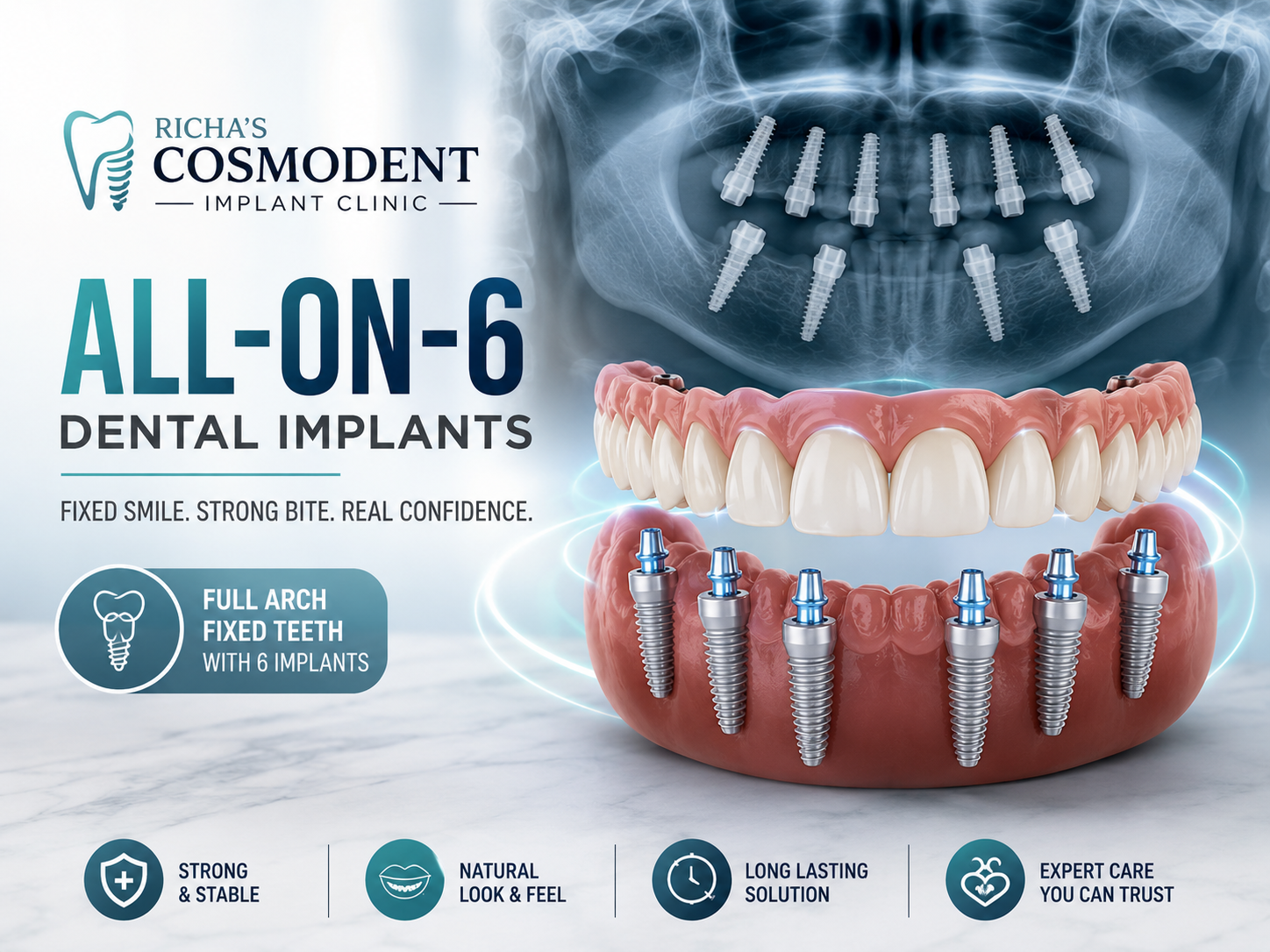
What if you could replace a failing or completely missing set of teeth with a fixed full-arch smile supported by dental implants instead of relying on removable dentures? For patients who have extensive tooth loss, All-on-6 dental implants can be one of the treatment approaches considered for restoring an entire dental arch.
All-on-6 dental implants in Mumbai use six strategically positioned dental implants to support a fixed full-arch prosthesis. However, the number of implants alone does not determine whether this treatment is right for you. Your bone condition, gums, bite, remaining teeth, overall health and long-term expectations all matter.
If you are considering full mouth dental implants in Mumbai, especially if you live in Mira Road or nearby areas, this guide explains how All-on-6 works, who may benefit, how it compares with All-on-4 and dentures, what recovery involves, and what can influence the treatment cost.
What Are All-on-6 Dental Implants?
All-on-6 is a full-arch implant treatment concept in which six dental implants support a fixed replacement arch of teeth.
Instead of replacing every missing tooth with an individual implant, the implants are strategically distributed across the jaw to support a full-arch prosthesis.
This can make All-on-6 an option for people who have:
- Multiple missing teeth
- Severely damaged or failing teeth
- Complete tooth loss in one dental arch
- Difficulty wearing conventional dentures
- Reduced chewing ability because of tooth loss
- A need for a fixed alternative to removable dentures
The treatment is different from placing six individual implants for six individual teeth. In All-on-6, the implants work together to support a complete arch.
Research on full-arch implant rehabilitation supports the use of multiple implants to retain fixed prostheses, although the ideal number and configuration depend on the patient’s anatomy and prosthetic plan.
How Do All-on-6 Implants Work?
The basic principle is straightforward: six implants are placed at carefully planned positions within the jaw, and these implants provide support for a fixed full-arch restoration.
However, the planning behind those six implants is far more important than simply counting them.
Before treatment, your dentist evaluates your:
- Jawbone volume and quality
- Gum health
- Remaining teeth
- Bite and opposing teeth
- Smile and facial aesthetics
- Sinus and nerve anatomy
- Overall medical history
- Oral hygiene habits
Advanced imaging such as CBCT 3D imaging can help the dental team evaluate the jawbone and important anatomical structures before surgery.
Digital treatment planning can then help coordinate implant placement with the final design of the teeth. This prosthetically driven approach aims to ensure that the implants are positioned not only where bone is available, but also where they can appropriately support the planned restoration.
Who Is a Good Candidate for All-on-6?
All-on-6 may be considered for adults who have extensive tooth loss or teeth that cannot be predictably restored.
You may be evaluated for this treatment if you have:
- Several missing teeth
- A completely edentulous dental arch
- Multiple failing or severely damaged teeth
- Loose or uncomfortable dentures
- Difficulty chewing with conventional dentures
- Adequate bone for planned implant placement
- Healthy or manageable gum conditions
However, not everyone with missing teeth automatically qualifies for All-on-6.
For example, active gum disease may need treatment before implant surgery. Similarly, severe bone loss may change the treatment plan. Depending on the situation, your dental implant specialist in Mumbai may discuss bone grafting, sinus augmentation, alternative implant positioning or other full-mouth rehabilitation options.
A proper examination is therefore more useful than trying to decide your eligibility from an online checklist.
All-on-6 Dental Implants in Mumbai: What Is the Procedure?
Although every treatment plan is individualized, the All-on-6 process usually involves several stages.
1. Consultation and dental examination
Your dentist first understands your concerns, dental history and treatment goals. The condition of your remaining teeth and gums is also evaluated.
2. Digital diagnostics
CBCT imaging and other digital records can help assess bone availability, anatomical structures and implant positioning.
3. Treatment planning
Your implant team plans the implant positions and designs the proposed full-arch restoration. The goal is to coordinate surgical and prosthetic considerations from the beginning.
4. Tooth removal, if required
If some remaining teeth are severely damaged and cannot be saved, extraction may form part of the treatment plan.
5. Implant placement
Six implants are placed in the selected arch according to the treatment plan.
6. Temporary or provisional teeth
For carefully selected patients who meet the necessary clinical requirements, a provisional fixed restoration may be provided soon after implant placement.
Immediate loading, however, is not appropriate for every patient. Implant stability, bone quality, bite forces and other clinical factors influence whether immediate loading is advisable.
7. Healing and follow-up
The dental team monitors healing and implant stability through scheduled appointments. During this period, you may receive specific dietary and oral hygiene instructions.
8. Final teeth
Once healing and clinical conditions are appropriate, the definitive full-arch prosthesis can be fabricated and fitted.
Your exact timeline can therefore vary considerably. A personalized treatment plan is more reliable than a fixed promise of completing every case within a particular number of days.
What Are the Benefits of All-on-6?
For suitable patients, All-on-6 can offer several potential benefits.
Fixed full-arch teeth
Unlike conventional removable dentures, the replacement teeth are supported by dental implants.
Improved stability
Implant-supported teeth can provide greater stability than traditional removable dentures, particularly during everyday activities such as eating and speaking.
Full-arch rehabilitation
The approach can address extensive tooth loss within one treatment plan rather than treating every missing tooth separately.
Strategic implant distribution
Six implants provide multiple points of support for the full-arch restoration. However, more implants do not automatically mean a better result; implant distribution and the overall prosthetic design also matter.
Potentially improved confidence
A stable full-arch restoration may help patients feel more comfortable when smiling, speaking and eating.
Ultimately, the goal is not simply to place six implants. The goal is to restore function, comfort, aesthetics and long-term oral health.
All-on-6 vs All-on-4: Which Is Better?
This is one of the most common questions patients ask.
All-on-4 uses four implants to support a full-arch restoration, while All-on-6 uses six.
It is tempting to assume that six implants must always be better than four. However, clinical evidence does not support such a simple conclusion.
A 2024 systematic review and meta-analysis comparing four- and six-implant-supported maxillary fixed prostheses found no significant differences in overall implant or prosthesis survival and several complication outcomes, although marginal bone loss was higher in the four-implant group in that analysis.
A newer 2026 systematic review likewise found broadly similar pooled outcomes between All-on-4 and All-on-6, while emphasizing variation between studies.
Therefore, the better question is not:
“Is All-on-6 always better than All-on-4?”
Instead, ask:
“Which full-arch implant design is appropriate for my bone, bite, anatomy and treatment goals?”
Your implant specialist can determine whether All-on-4, All-on-6 or another approach makes more sense after examination and imaging.
All-on-6 vs Dentures
Traditional dentures and All-on-6 serve different treatment approaches.
Dentures are removable and rest on the gums and supporting tissues. They can replace missing teeth without implant surgery.
All-on-6, on the other hand, uses implants within the jaw to support a fixed full-arch restoration.
| All-on-6 | Conventional Dentures |
|---|---|
| Implant-supported | Removable |
| Fixed full-arch restoration | Removable appliance |
| Requires implant surgery | Does not require implants |
| Designed for greater stability | Stability depends on tissue support and fit |
| Requires implant maintenance | Requires denture maintenance |
Neither option is automatically right for every patient.
Someone who cannot undergo implant surgery or prefers a removable solution may consider dentures. Someone seeking a fixed full-arch restoration may be evaluated for implant-supported treatment.
Can All-on-6 Replace All Missing Teeth?
Yes, All-on-6 is designed to support a complete dental arch, making it a potential treatment option for patients with extensive or complete tooth loss.
However, the prosthesis does not mean that six implants individually replace six teeth. Instead, the implants collectively support the full arch.
This distinction is important because the treatment focuses on restoring the entire dental arch as a functional unit.
If you have a tooth missing or only a few missing teeth, All-on-6 may not be necessary. A single dental implant, implant-supported bridge or another treatment may be more appropriate.
That is why the number and location of missing teeth should always be assessed before selecting a treatment.
Is Bone Grafting Required for All-on-6?
Not necessarily.
Some patients have enough healthy bone for planned implant placement, while others may have experienced significant bone loss following tooth extraction or long-term tooth loss.
If bone volume is insufficient, your dental implant specialist may discuss procedures such as:
- Bone grafting
- Guided bone regeneration
- Sinus lift
- Alternative implant positioning
- Other implant-supported solutions
The decision depends on the location and severity of bone loss.
This is also where CBCT imaging becomes valuable because it provides three-dimensional information that helps the dental team understand the available bone and nearby anatomical structures.
For patients with severe upper-jaw bone loss, other advanced options may also need consideration. The appropriate solution should always follow a clinical assessment rather than a generic treatment formula.
Can All-on-6 Provide Fixed Teeth Immediately?
In selected cases, patients may receive a provisional fixed restoration shortly after implant placement.
However, immediate loading requires appropriate implant stability and favorable clinical conditions. It should not be presented as a guaranteed outcome for every All-on-6 patient.
Your dentist may instead recommend a different loading schedule if the clinical situation requires additional healing time.
If you are searching for immediate dental implants in Mumbai or fixed teeth options, ask your implant specialist whether immediate loading is appropriate for your specific case.
All-on-6 Dental Implant Cost in Mumbai
The All-on-6 dental implant cost in Mumbai can vary significantly between patients.
A responsible estimate should consider the complete treatment rather than only the implant placement.
Factors that can influence the overall cost include:
- Number of arches being treated
- Condition of existing teeth
- Tooth extractions
- Bone availability
- Need for bone grafting
- Implant system
- Provisional restoration
- Final prosthesis material
- Digital planning and laboratory work
- Complexity of the case
- Follow-up and maintenance
For this reason, searching only for the cheapest All-on-6 implants cost in Mumbai may not give you a meaningful comparison.
Ask what the quoted treatment includes, what type of prosthesis is planned, whether additional procedures are required and what follow-up care is provided.
A consultation and diagnostic evaluation can give you a more accurate treatment estimate.
Recovery After All-on-6 Implant Surgery
Recovery varies according to the complexity of the procedure and your individual healing response.
After surgery, your dental team may advise you to:
- Follow the recommended diet
- Keep the surgical area clean as instructed
- Take prescribed medicines as directed
- Avoid smoking
- Avoid putting excessive pressure on the healing area
- Attend scheduled follow-up appointments
- Follow specific oral hygiene instructions
Some swelling, tenderness or discomfort can occur after implant surgery.
If you receive provisional teeth, your dentist may also recommend softer foods during the early healing period to reduce excessive loading on the implants.
Most importantly, do not judge implant success only by how quickly you feel better. Long-term maintenance and regular professional monitoring play an important role in protecting implant and gum health.
How Long Do All-on-6 Dental Implants Last?
All-on-6 is intended as a long-term tooth replacement solution, but no dental implant treatment should be described as permanent in the sense of requiring no future care.
Implant longevity can be influenced by:
- Oral hygiene
- Gum health
- Smoking
- Bite forces
- Bruxism or teeth grinding
- General health
- Prosthetic design
- Regular maintenance
- Professional follow-up
Importantly, implants and replacement teeth are not the same component. The implants can remain stable while the prosthetic teeth may eventually require repair, adjustment or replacement.
Long-term implant care therefore involves more than surgery. Regular examinations and professional maintenance help identify problems before they become more serious.
Advanced Dental Implant Technology at Richa’s Cosmodent
Modern full-mouth implant treatment increasingly combines clinical expertise with digital planning.
At Richa’s Cosmodent Implant Clinic, advanced dental technologies can support different stages of implant treatment, depending on the patient’s requirements.
These may include:
- CBCT 3D imaging for detailed evaluation and planning
- CAD-CAM technology for digitally designed dental restorations
- Digital dentistry workflows for improved communication between clinical and laboratory stages
- Robotic implant technology for selected implant procedures and precision-focused planning
Technology, however, should support—not replace—clinical judgment.
The final treatment decision should consider your oral health, bone condition, bite, aesthetics, prosthetic requirements and long-term maintenance needs.
Meet Our Dental Experts
Dr. Richa Mehta
BDS, MDS, FAGE
Prosthodontist & Cosmetic Dentist
Dr. Richa Mehta focuses on restoring both the function and appearance of the smile. Her areas of expertise include prosthodontics and cosmetic dentistry, with treatments such as smile designing, veneers, ceramic crowns, bridges, dentures and full-mouth rehabilitation.
Her approach emphasizes detailed treatment planning and patient comfort, particularly when patients require comprehensive restorative or full-mouth treatment.
Dr. Swapnil Pande
BDS, MDS (Implantology)
Leading Implant Specialist & Prosthodontist in Mumbai
Dr. Swapnil Pande focuses on advanced dental implantology and prosthodontics, including treatment planning for patients requiring single-tooth replacement and full-mouth dental implant rehabilitation.
His treatment approach combines implant expertise, digital planning and evidence-based techniques to develop individualized solutions for patients with extensive tooth loss.
For patients searching for a dental implant specialist in Mumbai, the combination of implantology, prosthodontic planning and digital technology can be particularly relevant when evaluating complex full-arch cases.
Why Consider All-on-6 Dental Implants in Mira Road, Mumbai?
If you live in Mira Road, Mumbai or nearby areas and are struggling with multiple missing or failing teeth, All-on-6 may be one of several full-arch treatment options worth discussing.
The right treatment depends on your individual clinical situation.
You may be a candidate for All-on-6. Alternatively, your dentist may recommend All-on-4, conventional dental implants, bone grafting, dentures or another rehabilitation approach.
The important step is to receive an accurate diagnosis before deciding.
At Richa’s Cosmodent Implant Clinic, patients can undergo evaluation and discuss implant treatment options using clinical examination, digital diagnostics and advanced treatment-planning technologies where appropriate.
Frequently Asked Questions
What are All-on-6 dental implants?
All-on-6 is a full-arch implant treatment concept in which six strategically placed dental implants support a fixed replacement arch of teeth.
Are All-on-6 dental implants better than All-on-4?
Not necessarily. Both approaches can provide successful full-arch rehabilitation. The appropriate option depends on bone availability, implant distribution, bite, prosthetic requirements and the patient’s individual clinical condition.
How much do All-on-6 dental implants cost in Mumbai?
The cost varies according to the number of arches, implant system, prosthetic material, existing teeth, bone condition, additional procedures and overall treatment complexity. A personalized estimate requires clinical evaluation.
Can I get All-on-6 implants if I have bone loss?
Possibly. Some patients with bone loss may still have suitable areas for implant placement, while others may require bone grafting or another treatment approach. CBCT imaging can help evaluate the available bone.
Can All-on-6 give me fixed teeth immediately?
Some carefully selected patients may receive a provisional fixed restoration soon after implant placement. However, immediate loading depends on implant stability and other clinical factors, so it cannot be guaranteed for every patient.
Are All-on-6 implants suitable for missing teeth?
All-on-6 is primarily designed for full-arch rehabilitation. If you have only one or a few missing teeth, individual dental implants or another tooth-replacement option may be more appropriate.
How long does All-on-6 treatment take?
The timeline varies. Some patients may receive provisional teeth relatively quickly, while others require a longer healing period before receiving their definitive restoration.
Do All-on-6 implants require maintenance?
Yes. Implant-supported teeth still require daily cleaning, professional check-ups and maintenance. Good oral hygiene is important for protecting both the implants and surrounding tissues.
Is All-on-6 available in Mira Road?
Patients in Mira Road can consult an implant-focused dental clinic to determine whether All-on-6 or another full-mouth rehabilitation option is suitable for their condition.
Final Takeaway
All-on-6 dental implants in Mumbai can provide a fixed full-arch solution for appropriately selected patients with extensive tooth loss or failing teeth. The treatment uses six strategically positioned implants to support a complete dental arch, but the number of implants is only one part of the decision.
Your bone condition, gums, bite, remaining teeth, overall health, aesthetics and long-term maintenance requirements all need consideration.
If you are comparing All-on-6 vs All-on-4, looking for full mouth dental implants in Mumbai, or exploring options for missing teeth, start with a detailed dental evaluation rather than choosing a treatment based solely on price.
For patients in Mira Road and across Mumbai, an experienced implant and prosthodontic team can help you understand whether All-on-6, All-on-4, conventional implants or another treatment approach is the better fit for your smile and oral health.
Leave a Reply