
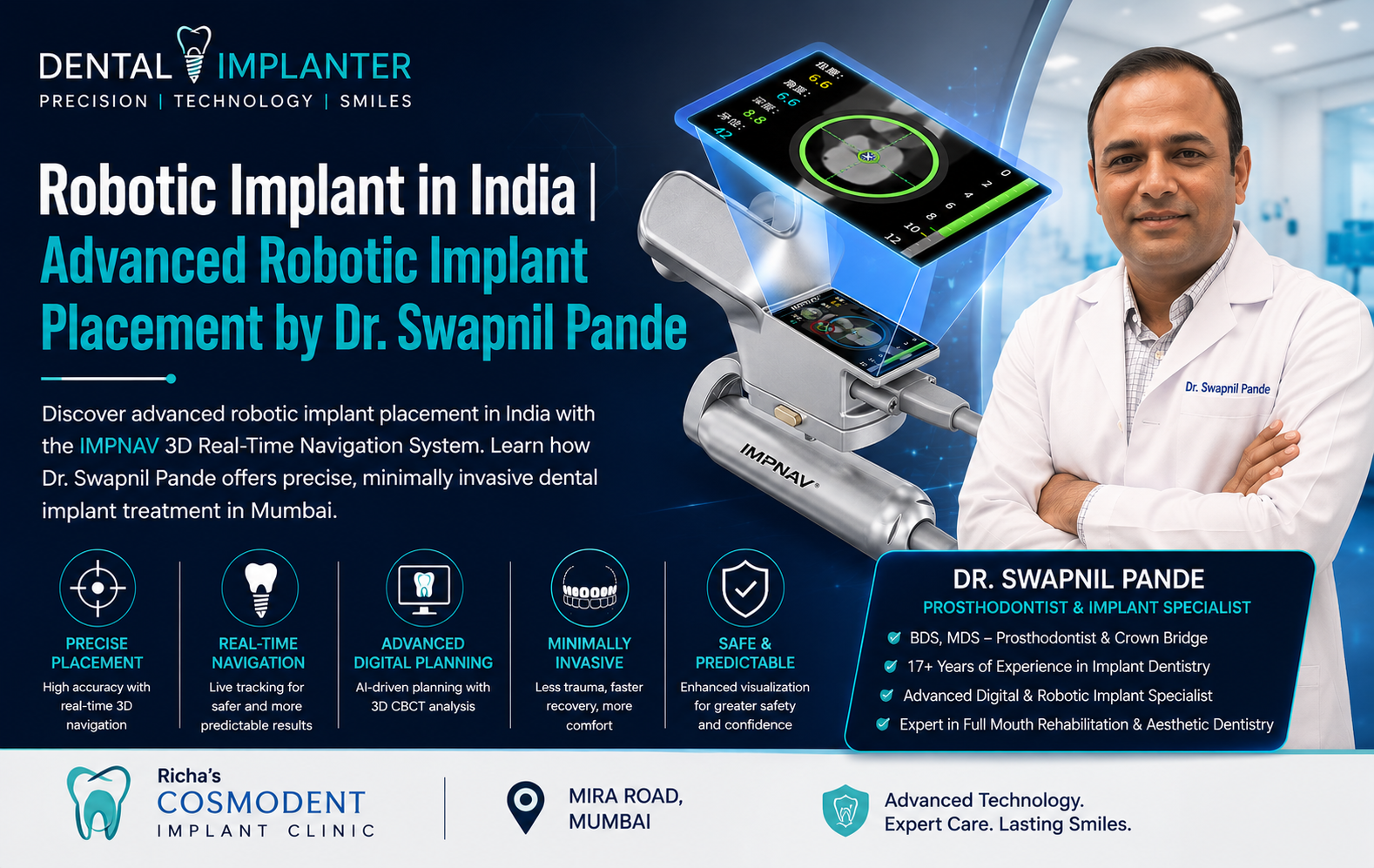
Dental implant technology has evolved rapidly over the past two decades, making tooth replacement safer, more predictable, and more comfortable than ever before. Today, a new generation of digital dentistry is transforming implant procedures through robotic-assisted dental implant placement, where advanced navigation technology supports the implant specialist with real-time guidance throughout surgery.
At the forefront of this advancement is the IMPNAV 3D Real-Time Implant Navigation System, an innovative digital platform designed to improve treatment planning and support highly accurate implant placement. By combining artificial intelligence, advanced imaging, three-dimensional planning, and dynamic navigation, this technology represents an exciting step forward in modern implant dentistry.
At Richa’s Cosmodent Implant Clinic and DentalImplanter.com, Dr. Swapnil Pande incorporates advanced digital technologies, including IMPNAV robotic implant placement, to deliver personalized treatment based on each patient’s unique oral condition. Rather than replacing the expertise of an implant specialist, robotic-assisted navigation enhances precision while allowing the clinician to remain in complete control throughout the procedure.
Whether you need to replace a single missing tooth, multiple missing teeth, or require full mouth dental implants, understanding how robotic implant placement in India works can help you make informed decisions about your oral health.
In this comprehensive guide, you’ll discover how robotic-assisted dental implant technology works, its advantages, who can benefit from it, and why advanced digital planning is changing the future of dental implants in Mumbai.
What Is a Robotic Implant? Everything You Need to Know
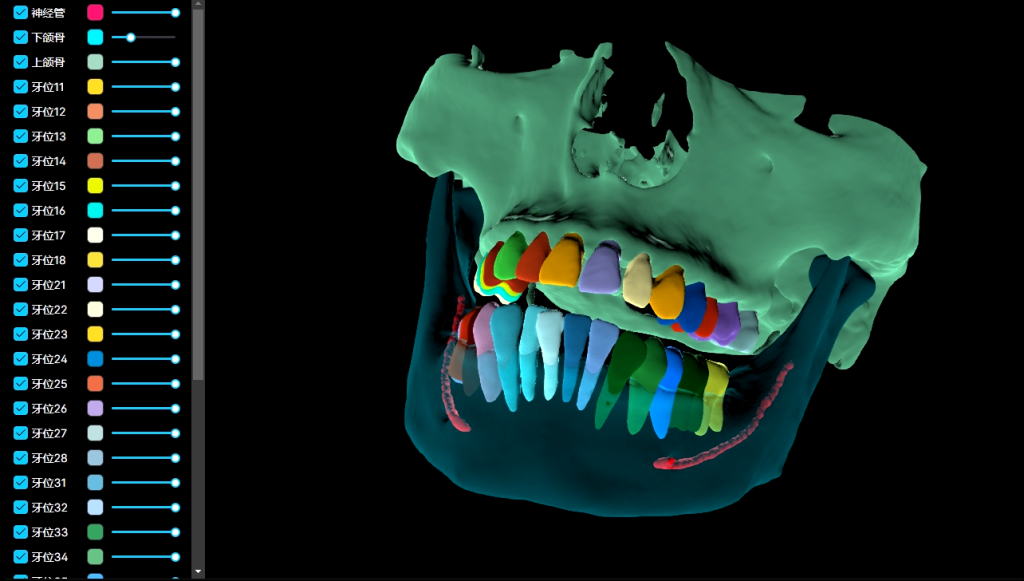
When people search for a robotic implant, they are usually referring to robotic-assisted dental implant placement—an advanced procedure that combines the experience of an implant specialist with intelligent digital navigation technology.
Unlike conventional implant surgery, robotic-assisted implant placement uses sophisticated software to guide the clinician before and during the procedure. Instead of relying only on static planning or manual estimation, the system provides continuous three-dimensional guidance that helps the dentist place the implant according to the planned position.
It’s important to understand that the implant itself is not robotic. The robotic component lies in the navigation technology, which assists the clinician throughout the procedure while the dentist remains fully responsible for every clinical decision.
Think of it like a GPS navigation system in a car. The GPS continuously shows the best route and alerts you if you move off course, but the driver remains in complete control. Similarly, the IMPNAV 3D Real-Time Navigation System guides the implant specialist during surgery without replacing clinical expertise.
This combination of advanced technology and experienced clinical judgment offers patients a modern approach to dental implants that emphasizes precision, planning, and personalized care.
How Does Robotic Implant Placement Work?
Every successful implant procedure begins long before the surgery itself.
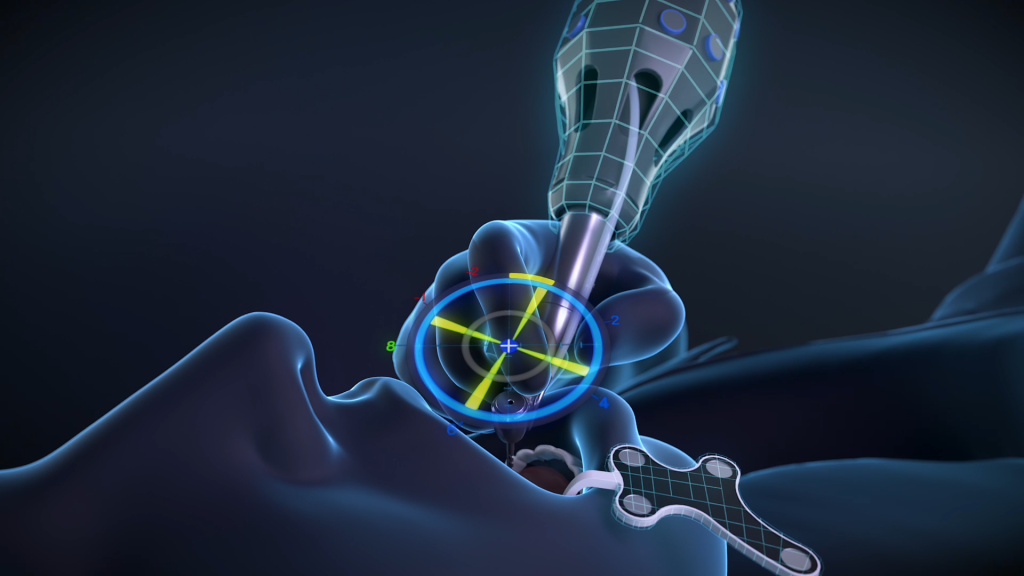
The first step involves capturing a Cone Beam Computed Tomography (CBCT) scan, which creates a highly detailed three-dimensional image of the patient’s jaw, teeth, bone, nerves, and surrounding structures.
The IMPNAV system then analyzes this information and automatically creates highly accurate 3D STL models, forming the foundation for digital treatment planning.
One of the most advanced capabilities of IMPNAV is its ability to simultaneously identify and segment multiple anatomical structures, including:
- Teeth
- Soft tissue
- Maxilla
- Mandible
- Maxillary sinus
- Inferior alveolar canal
- Incisive canal
- Cranial base
- Airways
These detailed digital models allow the implant specialist to evaluate bone quality, determine the ideal implant position, and develop a personalized treatment plan before surgery begins.
During the actual implant procedure, the navigation system continuously tracks the movement of the surgical handpiece in real time. As the implant specialist prepares the implant site, the system displays the drill’s exact position, angulation, and depth on a monitor.
This dynamic guidance helps ensure that the implant follows the planned trajectory while allowing the clinician to make adjustments whenever necessary.
Why Is Digital Planning So Important?
Every patient’s mouth is different. Bone density, nerve location, sinus anatomy, bite alignment, and gum health all influence how and where an implant should be placed.
Digital planning allows the implant specialist to study these details before treatment begins rather than making decisions only during surgery.
With robotic-assisted implant placement, clinicians can evaluate:
- Bone volume and quality
- Implant angulation
- Implant depth
- Distance from adjacent teeth
- Position of important nerves
- Maxillary sinus location
- Future prosthetic restoration
Careful planning supports a more personalized treatment experience and contributes to predictable long-term outcomes.
Robotic Implant in India Explained by Dr. Swapnil Pande
Modern dentistry is no longer limited to replacing missing teeth. Today’s focus is on restoring function, improving aesthetics, preserving healthy tissues, and delivering a comfortable patient experience through advanced technology.
Dr. Swapnil Pande, Prosthodontist and Implant Specialist, believes that successful implant treatment begins with accurate diagnosis and meticulous planning. By integrating IMPNAV 3D Real-Time Navigation Technology into clinical practice, he offers patients access to advanced digital workflows that support precise implant placement and enhanced visualization.
At Richa’s Cosmodent Implant Clinic, every implant case begins with a detailed consultation. The patient’s oral health, medical history, bone condition, bite relationship, and smile goals are carefully evaluated before creating a customized treatment plan.
Rather than adopting a one-size-fits-all approach, Dr. Pande tailors each implant procedure according to the patient’s individual needs. This personalized approach, combined with advanced digital technology, helps improve communication, planning, and overall treatment confidence.
Patients also benefit from interactive 3D models generated by the IMPNAV system, making it easier to understand their oral condition, visualize the treatment plan, and actively participate in treatment decisions.
Combining Clinical Expertise with Advanced Technology
While digital innovation continues to transform dentistry, technology alone does not guarantee successful outcomes.
The expertise of the implant specialist remains the most important factor in diagnosis, treatment planning, surgical execution, and long-term maintenance.
The role of IMPNAV is to support the clinician by providing:
- Real-time navigation
- Three-dimensional visualization
- Digital treatment planning
- Enhanced surgical precision
- Improved workflow efficiency
- Better patient education
This partnership between human expertise and intelligent technology represents the next evolution of implant dentistry.
Why More Patients Are Choosing Robotic Implant Placement
Patients today are more informed than ever before. They actively research treatment options, compare technologies, and look for procedures that prioritize safety, comfort, and long-term success.
This growing awareness has increased interest in robotic implant placement, particularly among individuals seeking advanced solutions for replacing missing teeth.
One of the main reasons patients choose this technology is its emphasis on precision. The ability to visualize the implant position in real time provides additional confidence throughout the procedure.
Another important advantage is personalization. Instead of following generalized treatment protocols, every implant is digitally planned according to the patient’s unique anatomy.
Patients also appreciate the improved communication that comes with advanced 3D visualization. Seeing a digital representation of their own jaw helps them better understand the procedure, ask informed questions, and feel more involved in the treatment process.
In appropriate clinical situations, robotic-assisted implant placement may also support minimally invasive treatment approaches, potentially reducing surgical trauma and improving post-operative comfort.
As digital dentistry continues to advance, technologies such as the IMPNAV 3D Real-Time Implant Navigation System are helping redefine the future of dental implants in Mumbai by combining intelligent planning, dynamic navigation, and experienced clinical care into one comprehensive treatment approach.
Key Benefits of Robotic Implant Placement with IMPNAV Technology
The success of a dental implant depends on several factors, including accurate diagnosis, careful treatment planning, surgical precision, and proper healing. While the experience of the implant specialist remains the foundation of successful treatment, advanced technologies like the IMPNAV 3D Real-Time Navigation System provide an additional level of guidance that supports more precise implant placement.
Robotic-assisted dental implant placement is designed to improve every stage of the treatment process—from planning and visualization to real-time surgical navigation. Let’s explore how this innovative technology benefits both patients and clinicians.
Greater Precision Through Real-Time Navigation
One of the biggest advantages of robotic implant placement is the ability to monitor the procedure in real time.
Unlike conventional implant surgery, where the dentist follows a pre-planned approach, IMPNAV continuously tracks the surgical handpiece throughout the procedure. This live navigation helps the implant specialist compare the actual drill position with the planned implant position on the screen.
The system is designed to deliver:
- 0.1 mm positioning accuracy
- 0.1 mm micro-motion recognition
- 360° real-time dynamic navigation
This advanced level of visualization supports highly accurate implant placement, particularly in areas where precision is critical, such as near the inferior alveolar nerve, maxillary sinus, or adjacent teeth.
For patients, greater precision can contribute to more predictable treatment outcomes and improved long-term implant stability.
Minimally Invasive Treatment for Greater Patient Comfort
Many people postpone replacing missing teeth because they are concerned about surgery. Fortunately, digital planning and robotic-assisted navigation can support a more conservative approach in suitable cases.
With detailed pre-operative planning and real-time guidance, the implant specialist can often perform the procedure with greater confidence while minimizing unnecessary tissue manipulation.
Potential benefits may include:
- Smaller surgical area where clinically appropriate
- Reduced trauma to surrounding tissues
- Less swelling after surgery
- Improved patient comfort
- Faster recovery
- Better preservation of healthy bone and soft tissue
Every patient is different, and the exact surgical approach depends on clinical findings, bone availability, and treatment goals.
Improved Safety Through Better Visualization
The jaw contains several important anatomical structures that must be carefully considered during implant surgery.
These include:
- Inferior alveolar nerve
- Mental nerve
- Maxillary sinus
- Adjacent tooth roots
- Blood vessels
- Soft tissue
The IMPNAV system creates a detailed three-dimensional view of these structures before treatment begins and continues providing navigation during surgery.
This enhanced visualization allows the implant specialist to perform treatment with greater awareness and precision, especially in complex clinical situations.
Personalized Digital Treatment Planning
No two implant cases are exactly alike.
Factors such as bone density, jaw anatomy, gum health, missing teeth, and bite alignment vary from patient to patient.
With robotic implant placement, every treatment begins with comprehensive digital planning.
Using CBCT imaging and IMPNAV software, the clinician evaluates:
- Bone quality
- Available bone volume
- Implant size
- Implant position
- Implant angulation
- Implant depth
- Final prosthetic restoration
- Functional bite relationship
This personalized planning supports more predictable treatment outcomes and helps ensure that the implant is positioned according to the patient’s individual anatomy.
Better Communication Through 3D Visualization
Understanding dental implant treatment can be difficult when patients only see traditional X-rays.
IMPNAV addresses this challenge by automatically generating highly detailed 3D STL models of the patient’s oral anatomy.
These digital models allow patients to visualize:
- Their missing teeth
- Bone condition
- Implant position
- Nerves
- Sinus location
- Final restoration plan
When patients can see their treatment in three dimensions, they often feel more informed and confident about the procedure.
Better understanding also encourages meaningful discussions between the patient and the implant specialist, leading to shared decision-making and greater trust.
Advanced Features of the IMPNAV 3D Real-Time Implant Navigation System
IMPNAV is more than a navigation device—it is a complete digital ecosystem that supports diagnosis, planning, visualization, and implant placement.
Its intelligent features help streamline clinical workflows while improving precision.
Fully Automated 3D STL Model Generation
One of IMPNAV’s most valuable capabilities is the automatic generation of highly detailed 3D STL models from CBCT data.
These digital models provide an accurate representation of the patient’s oral structures and serve as the foundation for digital implant planning.
STL models can be used for:
- Digital treatment planning
- Clinical case presentations
- Patient education
- Laboratory communication
- Surgical simulation
- 3D printing applications
This integrated workflow improves efficiency while supporting accurate treatment planning.
Intelligent AI-Based Anatomical Segmentation
IMPNAV uses advanced artificial intelligence to automatically identify and segment multiple anatomical structures from CBCT scans.
These include:
- Teeth
- Soft tissue
- Maxilla
- Mandible
- Maxillary sinus
- Inferior alveolar canal
- Incisive canal
- Cranial base
- Airways
By presenting these structures separately and clearly, the software enables the implant specialist to study the patient’s anatomy in exceptional detail before surgery begins.
This comprehensive visualization supports accurate planning and personalized treatment.
Dynamic 3D Navigation During Surgery
Unlike static surgical guides, which cannot adapt once treatment begins, IMPNAV continuously tracks the surgical instruments throughout the procedure.
This dynamic navigation provides the clinician with live visual feedback regarding:
- Drill position
- Implant angulation
- Implant depth
- Surgical trajectory
- Relationship to surrounding anatomy
Because the information updates continuously, the implant specialist can make informed adjustments while maintaining the original treatment objectives.
Efficient Digital Workflow
Modern implant dentistry is becoming increasingly digital.
IMPNAV integrates several essential stages of treatment into a single platform, including:
- Imaging
- Digital planning
- Navigation
- Visualization
- STL model generation
- Patient communication
This streamlined workflow improves efficiency for both clinicians and patients while supporting more organized treatment planning.
Who Can Benefit from Robotic Implant Placement?
Robotic-assisted implant placement is suitable for many patients who require replacement of missing teeth.
After a comprehensive clinical examination and diagnostic imaging, the implant specialist can determine whether this advanced technology is appropriate for a particular case.
Patients who may benefit include:
Patients Missing a Single Tooth
Accurate implant positioning is essential for achieving natural aesthetics, proper bite alignment, and long-term stability.
Patients Missing Multiple Teeth
Digital planning helps optimize implant positioning when replacing several teeth, supporting both function and appearance.
Full Mouth Dental Implant Patients
Patients undergoing complete smile rehabilitation often require multiple implants that must work together precisely.
Navigation-assisted technology supports detailed planning for these comprehensive treatments.
Immediate Implant Cases
In selected cases, implants may be placed immediately after tooth extraction.
Robotic-assisted navigation helps clinicians plan implant positioning based on the available bone and restorative requirements.
Patients with Reduced Bone Availability
When bone volume is limited, every millimeter matters.
Advanced navigation helps clinicians carefully evaluate available bone and position implants according to each patient’s anatomy.
Patients Looking for Advanced Dental Implant Technology
Patients interested in modern, digitally planned implant treatment often appreciate the precision, visualization, and personalized planning offered by robotic implant placement.
Whether replacing one tooth or restoring an entire smile, robotic-assisted technology represents an exciting advancement in contemporary implant dentistry.
Robotic Implant Placement vs Conventional Dental Implant Surgery
Dental implants have been successfully placed for decades using conventional surgical techniques. However, digital dentistry has introduced advanced navigation systems that enhance planning and provide real-time guidance during implant placement.
Robotic-assisted implant placement does not replace the skill of the implant specialist. Instead, it combines clinical expertise with intelligent navigation technology to support precise, personalized treatment.
| Feature | Conventional Dental Implant Surgery | Robotic Implant Placement with IMPNAV |
| Treatment Planning | Manual planning using CBCT and clinical assessment | AI-assisted digital planning with real-time navigation |
| Surgical Guidance | Clinical expertise and/or static surgical guides | Live 3D navigation throughout the procedure |
| Implant Position | Determined manually during surgery | Continuously monitored on-screen |
| Visualization | Limited to pre-operative planning | Dynamic real-time visualization |
| Precision | Depends on planning and experience | Enhanced by real-time digital guidance |
| Patient Communication | X-rays and conventional scans | Interactive 3D models and digital treatment planning |
| Workflow | Conventional | Fully digital workflow with planning, navigation, and visualization |
| Personalization | High | Advanced personalization using AI-assisted planning |
Both approaches can deliver excellent results when performed by an experienced implant specialist. Robotic implant placement simply provides an additional level of digital assistance that supports accuracy, visualization, and planning.
Why Choose Dr. Swapnil Pande for Robotic Implant Placement in Mumbai?
Choosing the right implant specialist is one of the most important decisions when replacing missing teeth. Advanced technology is valuable, but its true potential can only be realized when combined with clinical knowledge, careful diagnosis, and a patient-first approach.
Dr. Swapnil Pande is a Prosthodontist and Implant Specialist dedicated to providing advanced, evidence-based dental implant treatment. By incorporating the IMPNAV 3D Real-Time Navigation System into selected implant procedures, he continues to adopt modern digital innovations that support precision and personalized care.
At Richa’s Cosmodent Implant Clinic and DentalImplanter.com, every implant journey begins with a detailed consultation and comprehensive evaluation.
Patients benefit from:
- Personalized treatment planning
- Advanced CBCT-based diagnosis
- Digital smile and implant planning
- Modern navigation-assisted implant placement
- Minimally invasive treatment whenever clinically appropriate
- Comprehensive patient education using 3D visualization
- Long-term focus on function, aesthetics, and oral health
Every patient receives an individualized treatment plan based on their bone quality, oral condition, smile goals, and overall health.
A Patient-Centered Approach to Modern Implant Dentistry
Technology is only one part of successful treatment.
Dr. Swapnil Pande believes patients should understand every stage of their implant journey before treatment begins.
Using the 3D models generated by IMPNAV, patients can visualize:
- Their jawbone
- Missing teeth
- Available bone
- Implant position
- Final prosthetic plan
This interactive consultation improves understanding, encourages informed decision-making, and helps patients feel more confident about their treatment.
The Future of Dental Implants Is Digital
Digital dentistry is redefining how dental implants are planned and placed. Technologies such as the IMPNAV 3D Real-Time Implant Navigation System combine advanced imaging, artificial intelligence, digital planning, and real-time navigation into one integrated workflow.
Rather than relying solely on conventional methods, robotic-assisted implant placement enables clinicians to perform treatment with enhanced visualization and precision while maintaining complete clinical control.
For patients, this means a more personalized treatment experience, detailed digital planning, and improved understanding of their implant procedure.
As more dental practices embrace digital innovation, robotic-assisted implant placement is expected to play an increasingly important role in the future of implant dentistry.
If you are considering robotic implant placement in India, consulting an experienced implant specialist who utilizes advanced digital technology can help you explore treatment options tailored to your unique needs.
To learn more about robotic-assisted dental implant placement or schedule a consultation, visit DentalImplanter.com or Richa’s Cosmodent Implant Clinic.
Frequently Asked Questions About Robotic Implants
1. What is a robotic implant?
A robotic implant generally refers to robotic-assisted dental implant placement, where advanced navigation technology supports the implant specialist during surgery with real-time 3D guidance.
2. Is the implant placed by a robot?
No. The implant is placed by a qualified implant specialist. The robotic navigation system assists by providing continuous digital guidance during the procedure.
3. What is robotic implant placement?
Robotic implant placement is a digitally guided procedure that combines CBCT imaging, AI-assisted planning, and real-time navigation to support precise dental implant placement.
4. How does the IMPNAV navigation system work?
The system creates detailed 3D models from CBCT scans, assists with digital treatment planning, and provides real-time navigation throughout implant surgery.
5. Is robotic implant placement safe?
When performed by an experienced implant specialist with appropriate diagnosis and planning, robotic-assisted implant placement is designed to support precise and predictable treatment.
6. Is robotic implant placement painful?
The procedure is typically performed under local anesthesia. Most patients experience mild discomfort that can be managed with prescribed medications and post-operative care instructions.
7. Who is a suitable candidate for robotic implant placement?
Patients with one or more missing teeth, full-mouth rehabilitation needs, immediate implant cases, or complex anatomical situations may benefit after a thorough clinical evaluation.
8. Can robotic implant placement be used for full-mouth dental implants?
Yes. Advanced navigation technology can assist in planning and placing multiple implants for selected full-mouth rehabilitation cases.
9. Where can I get robotic implant placement in Mumbai?
Patients can consult Dr. Swapnil Pande at DentalImplanter.com and Richa’s Cosmodent Implant Clinic to determine whether robotic-assisted implant placement is suitable for their needs.
10. Why choose Dr. Swapnil Pande for dental implants?
Dr. Swapnil Pande combines advanced digital technology, personalized treatment planning, and extensive experience in implant dentistry to provide patient-focused care and predictable outcomes.
Leave a Reply