
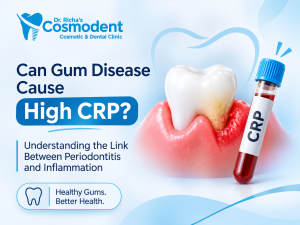
An elevated C-reactive protein (CRP) level on a routine blood test can raise questions, especially when you feel healthy and have no obvious symptoms of infection. While doctors investigate several possible causes of inflammation, one potential contributor sometimes goes unnoticed: gum disease, also known as periodontal disease.
Gum disease can develop gradually, often without significant pain during its early stages. As the condition progresses, inflammation can affect the tissues supporting your teeth and may contribute to inflammation elsewhere in the body.
Research has linked periodontitis with higher circulating CRP levels. Furthermore, studies suggest that treating periodontal disease can reduce CRP in some patients. However, gum disease is only one possible explanation for an elevated result, and dental treatment cannot guarantee that CRP will return to normal.
Understanding this connection can help you make informed decisions about your oral health and overall well-being.
What Is CRP, and Why Can Its Levels Increase?
C-reactive protein is a substance produced primarily by the liver in response to inflammation. When the immune system detects an infection, tissue injury, or another inflammatory trigger, the body increases CRP production.
Doctors measure CRP through a blood test to help assess inflammation. They may also request a high-sensitivity CRP (hs-CRP) test when they need to detect lower levels of inflammation, including in certain cardiovascular risk assessments.
An elevated CRP result does not identify the exact source of inflammation. Instead, it provides a clue that the healthcare team may need to investigate further.
Common causes of elevated CRP
CRP levels can increase for several reasons, including:
- Bacterial or viral infections.
- Autoimmune and inflammatory conditions.
- Recent injuries, surgery, or tissue damage.
- Certain chronic health conditions.
- Obesity, smoking, and other factors associated with inflammation.
- Periodontal disease, particularly when it causes persistent gum inflammation.
The significance of a result depends on the actual value, the laboratory’s reference range, your symptoms, medical history, and the reason your doctor ordered the test.
Therefore, if your CRP level is high, consult your doctor for an appropriate interpretation rather than assuming that a dental problem is responsible.
How Can Gum Disease Contribute to High CRP Levels?
To understand the relationship between gum disease and high CRP, it helps to understand what happens when the tissues around your teeth become inflamed.
Healthy gums fit closely around the teeth and help protect the underlying tissues. However, plaque can accumulate along the gumline when daily oral hygiene does not adequately remove it. Plaque contains bacteria that can irritate the gums and trigger an inflammatory response.
If the inflammation persists, gingivitis may progress to periodontitis in susceptible individuals. Periodontitis damages the tissues and bone that support the teeth.
1. Bacterial plaque triggers inflammation
Dental plaque is a sticky biofilm that forms continuously on teeth. When it remains undisturbed, it can contribute to gum inflammation. Over time, plaque may harden into calculus, commonly called tartar, which cannot be removed effectively with a toothbrush alone.
As the condition progresses, bacteria and the body’s immune response can damage the tissues around the teeth.
2. Periodontal pockets allow inflammation to persist
Periodontitis can create deeper spaces between the teeth and gums, known as periodontal pockets. These pockets may harbour bacterial biofilm and become difficult to clean with ordinary brushing and flossing.
The inflamed gum tissue may also become more vulnerable to minor bleeding and bacterial entry into the circulation.
3. The immune response can affect the rest of the body
The body responds to periodontal bacteria by releasing inflammatory mediators, including cytokines. These signalling molecules help coordinate immune activity and can stimulate the liver to produce more CRP.
Consequently, persistent periodontal inflammation may contribute to the body’s overall inflammatory burden.
However, this process does not mean that every person with gum disease will develop elevated CRP. Similarly, not every person with elevated CRP has periodontal disease.
Can You Have Gum Disease Without Pain or Bleeding?
Yes. Gum disease does not always cause noticeable discomfort, particularly in its early stages.
Some people dismiss occasional bleeding during brushing as normal. Others notice bad breath but assume that mouthwash alone will solve the problem. Meanwhile, periodontal inflammation may continue to progress.
Look out for these possible warning signs:
- Gums that bleed during brushing or flossing.
- Red, swollen, or tender gums.
- Persistent bad breath or an unpleasant taste.
- Gums that appear to recede from the teeth.
- Teeth that feel loose or have shifted position.
- Pus or discharge around the gums.
- Changes in the way your teeth fit together when you bite.
These symptoms do not establish a diagnosis by themselves. Nevertheless, they are good reasons to arrange a dental examination.
Even if your gums do not hurt, regular dental check-ups can help identify periodontal problems before they cause more extensive damage.
Does Scientific Research Support a Link Between Periodontitis and CRP?
Yes. Several systematic reviews have examined the relationship between periodontal disease and systemic inflammation.
A systematic review published in 2021 found that periodontitis was consistently associated with higher CRP and high-sensitivity CRP levels compared with healthy control groups. The researchers also found that periodontal treatment could influence hs-CRP levels over time.
A further systematic review and meta-analysis published in the Journal of Clinical Periodontology in 2023 evaluated 26 randomised clinical trials involving 2,579 participants. The analysis reported an average CRP reduction of approximately 0.69 mg/L at six months following periodontal treatment.
These findings support a relationship between periodontal inflammation and systemic inflammation. However, the studies showed variation in treatment approaches, patient characteristics, and outcomes. Evidence about whether the reduction persists beyond six months was limited.
Most importantly, a change in CRP does not automatically translate into a proven reduction in heart attacks, strokes, or other major health events.
Therefore, periodontal treatment should primarily address diagnosed gum disease and protect the teeth and supporting tissues. Any potential systemic benefit is an additional consideration, not a guaranteed outcome.
Can Deep Teeth Cleaning Help Reduce Elevated CRP?
When a dental examination confirms periodontitis, a dentist may recommend scaling and root planing, also called deep cleaning.
Unlike routine cleaning, which primarily removes deposits from accessible tooth surfaces, this procedure targets plaque and calculus below the gumline.
The dentist or periodontal specialist selects the treatment approach according to the depth of the periodontal pockets, the amount of calculus, the degree of tissue damage, and the patient’s overall oral health.
How scaling and root planing works
1. Removes plaque and calculus
The dental professional uses appropriate instruments to remove bacterial deposits from the teeth and root surfaces, including areas beneath the gumline.
2. Reduces local sources of irritation
Removing deposits helps reduce the bacterial burden that contributes to periodontal inflammation. The gums can then begin to heal, provided the patient maintains effective oral hygiene and follows the recommended treatment plan.
3. Supports healthier gum tissue
As inflammation improves, the gums may become less swollen and bleed less easily. Periodontal pocket measurements can also improve, although existing bone loss is not necessarily reversed by deep cleaning alone.
4. Helps manage the overall inflammatory burden
By treating active periodontal disease, the procedure may also reduce a source of systemic inflammation. Research suggests that CRP levels can decrease in some patients following periodontal therapy, although individual results vary.
Deep cleaning does not directly treat every possible cause of elevated CRP. Your doctor may still need to investigate other medical conditions or repeat blood tests when appropriate.
What Happens During a Deep Cleaning Appointment?
The treatment process depends on your periodontal condition and individual needs. In general, a dental visit may involve the following steps.
Step 1: Gum health assessment
The dentist reviews your symptoms and dental history, examines the gums, and measures periodontal pocket depths. Dental X-rays may help assess supporting bone when clinically indicated.
Step 2: Personalised treatment planning
The dentist explains the findings and recommends suitable treatment. Depending on the severity and extent of the disease, deep cleaning may take place over one or more appointments.
Step 3: Scaling and root planing
The dental professional removes plaque and hardened deposits from the affected areas. Local anaesthesia may be used to improve comfort when needed.
Step 4: Healing and reassessment
After treatment, you may experience temporary tenderness or tooth sensitivity. Your dentist will advise you on oral hygiene and arrange a follow-up assessment to check healing and periodontal response.
Some patients need additional periodontal treatment or ongoing maintenance to control the disease.
Who Should Consider a Periodontal Evaluation?
A gum health assessment may be particularly helpful if you experience persistent gum bleeding, swollen gums, bad breath, gum recession, or loose teeth.
It may also be worth discussing your oral health with a dentist if your doctor is investigating persistently elevated CRP and you have not had a recent dental examination.
However, do not delay medical assessment while waiting for a dental appointment. A substantially elevated CRP level, fever, worsening symptoms, or signs of a spreading infection require prompt medical attention, depending on the circumstances.
People with diabetes, a history of smoking, or other factors associated with periodontal disease may need particular attention to gum health. Your dentist can help determine the appropriate examination and maintenance schedule.
How Can You Maintain Healthy Gums After Treatment?
Professional treatment is only one part of periodontal care. Daily habits play an important role in preventing plaque accumulation and maintaining healthier gums.
- Brush twice daily: Use a soft-bristled toothbrush and fluoride toothpaste, paying attention to the gumline.
- Clean between your teeth: Use interdental brushes or dental floss according to your needs and your dentist’s advice.
- Attend follow-up appointments: Periodontal maintenance helps monitor the condition and remove deposits that accumulate over time.
- Avoid tobacco: Smoking increases the risk of periodontal disease and can interfere with healing.
- Manage underlying health conditions: Work with your healthcare team to manage conditions such as diabetes that can affect gum health.
- Maintain a balanced lifestyle: A nutritious diet, adequate sleep, and regular physical activity support general health, although they cannot replace periodontal treatment when it is needed.
Consistency matters. Even after successful treatment, periodontitis can recur if plaque control and professional maintenance are inadequate.
Where Can You Get a Gum Health Assessment in Mira Road?
If you are experiencing gum bleeding, persistent bad breath, or other signs of periodontal disease, a dental evaluation can help identify the cause and determine whether professional cleaning is appropriate.
At Richa’s Cosmodent Implant Clinic, patients can discuss their oral health concerns with qualified dental professionals and receive guidance based on an individual clinical assessment.
If you are looking for a dentist in Mira Road, the clinic is located at Flat No. 004, Sahyadri Co-operative Housing Society, B-15, opposite Allahabad Bank, Sector 9, Shanti Nagar, Mira Road East, Mira Bhayandar, Maharashtra 401107.
The clinic’s opening hours are Monday to Saturday, 9:30 AM to 9:30 PM. It is closed on Sundays.
You can learn more about the clinic and its dental care services on the Mira Road dental clinic page or contact Richa’s Cosmodent to discuss an appointment.
During your consultation, mention any recent CRP results, relevant symptoms, medications, and existing medical conditions. Your dentist can assess your gums and recommend appropriate dental care, while your physician can continue investigating the blood test result.
Frequently Asked Questions
1. Can gum disease cause high CRP levels?
Gum disease, particularly periodontitis, is associated with increased systemic inflammation and higher CRP levels in some people. However, elevated CRP has many possible causes, so it cannot be attributed to gum disease without an appropriate assessment.
2. Can deep cleaning lower CRP levels?
Research suggests that scaling and root planing and other periodontal treatments can reduce CRP levels in some patients. The degree of change varies, and treatment does not guarantee normal CRP levels.
3. Can gum disease exist without pain?
Yes. Periodontitis can progress with few noticeable symptoms. Bleeding gums, persistent bad breath, gum recession, and loose teeth may indicate a problem even when there is no pain.
4. How long does CRP take to decrease after gum treatment?
Studies have reported reductions over subsequent weeks and months, with evidence supporting an average reduction at six months in some analyses. The timing and extent of any change depend on several factors, and repeat testing should follow your physician’s advice.
5. Should I see a dentist if my CRP is elevated?
Consider a dental examination if you have signs of gum disease or have not had a recent oral health assessment. However, do not rely on dental treatment alone to explain or manage elevated CRP. Your doctor should assess other possible causes.
6. Is scaling and root planing the same as routine teeth cleaning?
No. Routine cleaning generally focuses on accessible tooth surfaces, while scaling and root planing targets plaque and calculus beneath the gumline when periodontal disease requires treatment.
Conclusion: Look Beyond the Blood Test
An elevated CRP result can have many explanations, and periodontal disease is one potential contributor that deserves attention. Research supports an association between periodontitis and systemic inflammation, while also suggesting that effective periodontal treatment may reduce CRP in some patients.
Nevertheless, a dental examination cannot replace a medical investigation, and deep cleaning is not a guaranteed treatment for unexplained inflammation.
If you have bleeding gums, persistent bad breath, gum recession, or concerns about your periodontal health, arrange an assessment with a qualified dental professional. Early diagnosis, appropriate treatment, and consistent oral hygiene can help protect your gums, preserve your teeth, and support better long-term oral health.