
Medically reviewed by Dr. Swapnil Pande, Cosmodent Implant Clinic, Mumbai
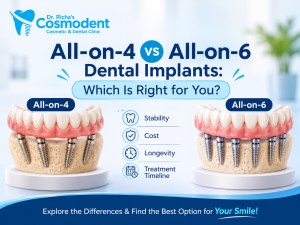
All-on-4 uses four implants per jaw to hold a full fixed set of teeth, while All-on-6 uses six. The extra two implants spread chewing force across more support, which helps in some jaws and costs more. Both give you fixed teeth in place of dentures, so the right choice depends on your bone, your bite and your budget. This guide compares the two side by side.
Key takeaways
- Both options replace a full arch with a fixed bridge on implants.
- All-on-4 relies on four strategically angled implants and can avoid grafting in some cases.
- All-on-6 adds support and often suits softer bone or longer bridges.
- Only a 3D scan and an exam can tell you which option fits you.
What is the difference between All-on-4 and All-on-6?
| Feature | All-on-4 | All-on-6 |
| Number of implants per jaw | 4 | 6 |
| Typical use | Good front bone, wish to avoid grafting | Softer bone, wider arch or heavier bite |
| Load sharing | Fewer anchors | More anchors, wider spread |
| Back teeth support | Often shorter extensions | Often fuller support |
| Cost tier | Lower | Higher (more implants) |
| Surgery | Shorter | Slightly longer |
| Fallback if one implant fails | Less margin | More margin |
In short, All-on-4 is the efficient option, and All-on-6 is the reinforced one. To learn the basics of each, read our pages on All-on-4 dental implants and All-on-6 dental implants.
How does All-on-4 work?
Your surgeon places four implants in each jaw. Two sit at the front, and two sit at the back at an angle. This angle lets the implants use the denser bone available and often avoids a bone graft. Then a fixed bridge attaches on top, often on the same day as a temporary set. If you want to see how same-day teeth work, read about immediate dental implants and immediate teeth.
How does All-on-6 work?
Six implants share the load, which gives extra stability and a wider base of support. As a result, many clinicians prefer this option when bone quality is softer, especially in the upper jaw, or when the bridge needs to extend further back.
Which option is better for you?
Is All-on-4 enough for most patients?
It works well when you have adequate bone at the front and a moderate bite force. Many patients enjoy excellent long-term results with it.
When does All-on-6 make more sense?
Choose it, or ask your surgeon about it, if you:
- Have softer bone, especially in the upper jaw
- Clench or grind your teeth heavily
- Want extra margin for long-term security
- Need a longer bridge that extends towards the back
What if you have severe bone loss?
Neither option works without enough bone. However, advanced alternatives such as zygomatic implants and pterygoid implants can help when standard sites lack bone. Read our guide to dental implants with bone loss to compare them.
How do cost and recovery compare?
All-on-6 costs more because it needs two additional implants and a slightly longer procedure. Recovery looks similar for both: you may feel swelling and soreness for several days, you eat soft foods for a few weeks, and you return for follow-ups as the bone heals. For price ranges, see our dental implant cost guide, and for the timeline read our healing guide.
How does computer-guided planning help?
A 3D scan maps your bone, sinuses and nerves before surgery. Guided planning then places each implant precisely, so you gain accuracy and often faster healing. Learn more on our guided implantology page and our full-mouth guided implants page.
How do you decide between All-on-4 and All-on-6?
Follow these steps. First, book a consultation and a 3D scan. Next, ask your surgeon to explain your bone volume in plain language. Then request a written plan for both options with prices. Finally, compare stability, cost and your comfort level. Our full-mouth dental implants page outlines the wider treatment journey.
Frequently asked questions about All-on-4 vs All-on-6
Is All-on-6 better than All-on-4?
Not automatically. All-on-6 gives extra support, but All-on-4 works very well in suitable jaws. Your scan decides.
Which is cheaper, All-on-4 or All-on-6?
All-on-4 usually costs less because it uses fewer implants.
Can I get teeth the same day with either option?
Often yes, if your bone allows immediate loading. Your surgeon will confirm this after your assessment.
How long do All-on-4 and All-on-6 last?
With good hygiene and regular check-ups, the implants can last for many years. The bridge may need maintenance or replacement over time.
Are All-on-4 and All-on-6 removable?
They are fixed, so you do not remove them at home. Your dentist can remove the bridge for cleaning and servicing.
Who is not a candidate?
People with uncontrolled diabetes, active gum disease or very low bone may need preparation first or an alternative plan.
How do I clean All-on-4 or All-on-6 teeth?
Brush twice daily, use a water flosser or interdental brushes under the bridge and attend regular professional cleanings.
Find out which option suits you
Dr. Swapnil Pande and the Cosmodent team review your 3D scan, explain both options in plain language and give you a clear plan. Visit our services page, read about the clinic or book at Mira Road or Kandivali.
Disclaimer: This article offers general information and does not replace a personal dental examination. Treatment suitability varies by patient.